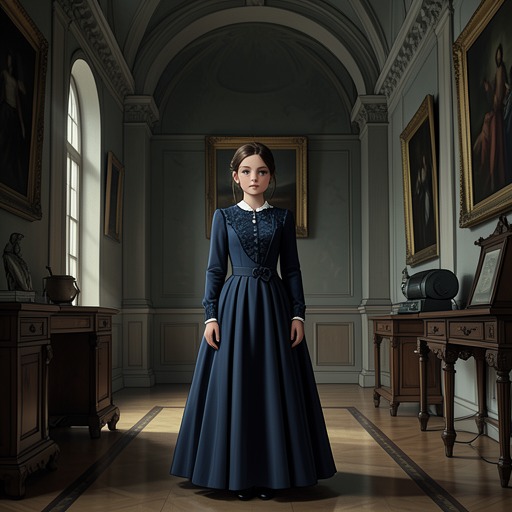
The constant princess
The Constant PrincessThe constant princess is Catalina of Aragon’s self-fashioned identity during the long years after Arthur, Prince of Wales, dies. The phrase names more than patience: it binds her to a promise, sustains her claim to a future as Queen of England, and distinguishes endurance from surrender. Yet the image changes under pressure. What first sounds like steadfast hope becomes, in the coldest period of her waiting, a determination so rigid that Catalina fears it has turned her to stone.
Identity and the promise
Catalina first defines constancy through waiting. When her duenna asks whether she is a princess or a prisoner, and how long she can be left without a marriage or permission to return home, Catalina answers calmly, “I am waiting.” She insists that she will wait patiently until the matter is resolved. The answer is a deliberate posture in a situation she cannot command: others control her marriage negotiations, her movements, and her place at court, but she can decide not to abandon the future she expects.
Her resolve is anchored in the promise she made to Arthur. Remembering Spain, Katherine's homeland, and the seasonal renewal of the Alhambra Palace, she calls herself a sentry who keeps watch rather than a soldier who forgets duty. She recalls saying, “I promise,” and declares that she will remain constant to Arthur. The garden of al-Yanna, the rose, and Arthur himself belong to the hoped-for reunion she imagines beyond death; meanwhile, she will be Queen of England as she believes she was born to be and as she promised him she would be. The closing image joins the two futures: the rose will bloom in England as well as in heaven. Constancy thus links marital fidelity, religious imagination, and political ambition without allowing one to replace the others.
Waiting at the margins of court
The name acquires political force because waiting is imposed on Catalina as well as chosen by her. During the year of mourning for Arthur, her claim that the marriage was never consummated fails to bring the new betrothal she expected. Instead, she is pushed further from court life, summoned only for major occasions and reliant on Elizabeth of York’s kindness. Margaret Beaufort regards the impoverished widow as of little use to the Tudor family: she brings no new money, is no longer a useful prospect for producing an heir, and has become a bargaining counter in dealings with Spain. Catalina’s persistence therefore does not mean that she is in control of events. It means that she continues to hold to her purpose while others treat her as expendable.
The same tension sharpens when Henry VII pursues a marriage to Juana of Castile. Catalina believes the plan would put her widowed sister above her on the English throne and reduce her to nothing; she is also made to recommend the match, speaking of Juana’s beauty under her father’s orders and urging her father to accept Henry’s suit under the king’s. She later recalls that fear left her unable to refuse Henry, whom she regarded as her persecutor, father-in-law, and would-be seducer. The episode marks how little freedom her royal position guarantees. Yet she distinguishes being reduced from being defeated: she loses confidence in her allure and abilities, she says, but not her will to live.
Constancy tested by deprivation
Catalina makes the phrase explicit in the face of this accumulation of losses: “I gritted my teeth, I am the constant princess, I don’t stop when everyone else stops.” The repeated verbs—carrying on and waiting—turn constancy into practice rather than a title bestowed by birth. She describes the years from sixteen to twenty-three as a bitter growing up, from a girl ready for love to a half-orphaned, lonely widow. Childhood happiness in the Alhambra Palace and her love for Arthur become inward resources. She finds her dead mother’s determination and courage within herself, alongside Arthur’s love and optimism, and vows to be Queen of England despite poverty, neglect, and the absence of prospects.
The phrase also takes on a material test when Catalina’s dowry arrives. Believing it will finally make a marriage possible, she welcomes the prospect of a double wedding. But Gutierre Gómez de Fuensalida has withheld the treasure because Henry would have used it to pay soldiers fighting against her father, effectively making her dowry finance war on Spain. Catalina protests that it was her side of the bargain: she has gone without food and given up her own house rather than pawn the treasure, because she keeps faith with a promise whatever the cost. Her accusation that she has been robbed exposes the painful difference between her own fidelity and the political actors’ use of her property. Constancy is not simply staying in place; it is keeping an obligation that the people around her do not honor in the same way.
From the constant princess to the snow princess
By the seventh year, constancy has become harder to distinguish from emotional shutdown. Catalina imagines herself as a sleeping princess in a cold land, longing for the heat of Spain and fearing that, if Henry dies and the prince marries someone else, she will ask her father to let her enter a convent. She admits that she wishes she had died with Arthur. This is a change in the texture of her waiting: the earlier promise had sustained an active vision of England and heaven, but now the cold seems to have taken hold within her.
She nevertheless refuses to call this state despair. The women in her family, she says, dissolve into despair, whereas she feels her determination to be queen has turned her to stone. Her self-description as “a princess of constant snow” darkens the earlier title without wholly abandoning it. She is not claiming that she has recovered hope or feeling. She is claiming that she has not yielded, even as she recognizes the cost of survival by sheer will.
The same change reaches her faith. Catalina can no longer sense God’s presence, fear His will, or take joy in His blessing; she no longer comforts herself with the belief that she is specially chosen either for blessing or for testing. Her earthly father’s apparent forgetting makes divine abandonment seem possible too. At this low point, only two attachments remain vivid: her love for Arthur and her longing for Spain, the Alhambra Palace, and al-Yanna. The constant princess is therefore not an image of effortless resilience. It is a self-description repeatedly tested by bereavement, dependence, betrayal, and spiritual desolation—a promise maintained even when the warmth and certainty that first sustained it have nearly vanished.